Smart separators for sustainable batteries
The Heal B and B project is developing a new generation of functional separators for lithium‑ion batteries, transforming this component — traditionally chemically passive — into an active element for improving cell stability and longevity. The objective is to limit electrochemical aging processes, in particular the degradation of the Solid Electrolyte Interphase (SEI) — a protective layer at the negative electrode’s surface. This degradation is often caused by the migration and electro‑reduction of transition metals (such as nickel and manganese) dissolved from the cathode, which accelerate SEI breakdown and the performance loss of batteries.
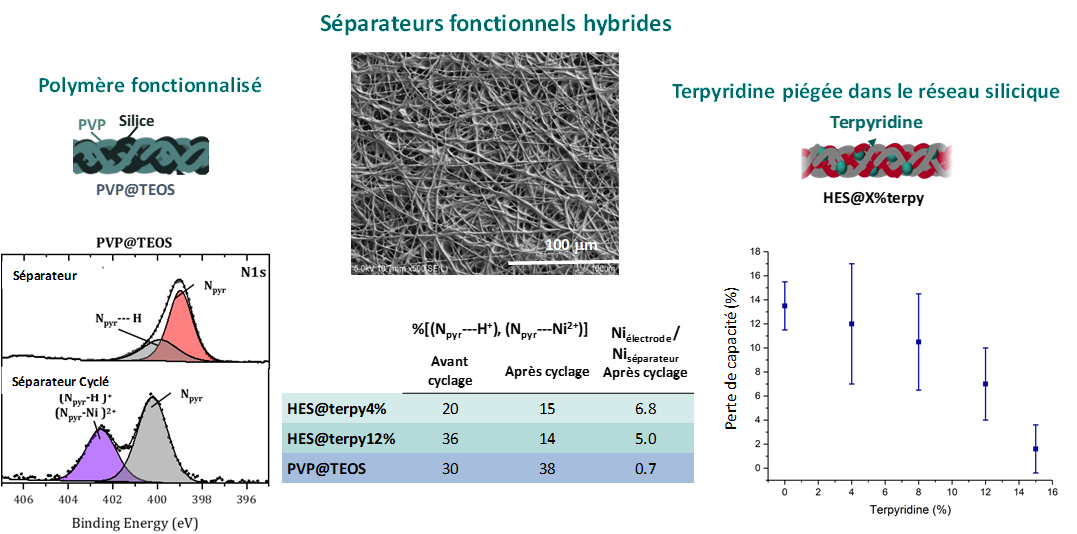
To address this challenge, Heal B and B designs separators via extrusion under field conditions, producing hybrid fibres combining a polymer and a siliceous network. This architecture creates a controlled porous network essential for electrolyte impregnation and lithium‑ion mobility.
The key innovation lies in incorporating terpyridine groups, known for their strong affinity with Ni²⁺ and Mn²⁺ ions. These ligands are integrated either into the siliceous matrix or into the polymer phase using polyvinylpyrrolidone (PVP). They enable selective trapping of transition‑metal ions, preventing their migration to the negative electrode and thus preserving the SEI. Additionally, terpyridine can also bind protons (H⁺), which when combined with electrolyte fluorides form hydrofluoric acid (HF) — a corrosive by‑product of fluorinated electrolytes — thereby limiting parasitic reactions and stabilizing the cell’s internal electrochemical environment.
Initial results, obtained from electrochemical cycling and ex‑situ separator analysis by X‑ray photoelectron spectroscopy (XPS), show that these separators effectively capture Ni²⁺ ions depending on terpyridine content and reduce their accumulation near the negative electrode, while also showing promising potential for HF neutralization.
By transforming the separator into an active stabilizing chemical element, Heal B and B opens the way for integrated strategies that slow battery aging without modifying electrodes or electrolytes. This approach contributes to the development of more robust, durable, and reliable batteries suited to the growing demands of long‑term energy storage.
Autres Highlights