First milestones of organic anion-ion batteries
The SONIC project aims to develop “anion-ion” batteries using organic electrode materials and a solid polymer electrolyte, completely free of critical elements such as lithium, cobalt, or nickel. The approach relies exclusively on p-type organic redox compounds with anionic charge compensation and cationic polymer electrolytes that conduct only anions (BF₄⁻), with the ultimate goal of integrating them into a pouch cell.
This strategy seeks to replace traditionally metallic electroactive centers with organic motifs (C, H, O, N, S) and to use an anion insertion/extraction mechanism, paving the way for 100% molecular, more sustainable batteries. At this stage of the project, research efforts are primarily led by four PhD students distributed across IMN, LRCS, CEA, and IFPEN, with strong collaboration with LEPMI. The company WeLoop is also involved to help select chemical conditions with the lowest environmental impact in terms of eco-indicators.
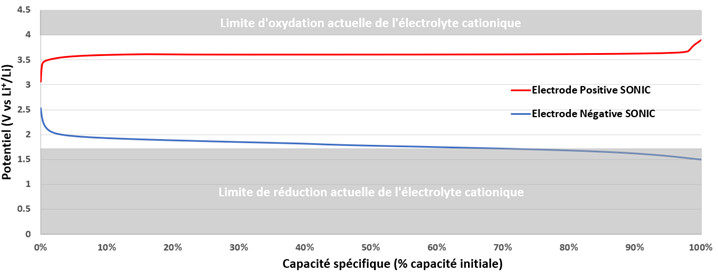
On the positive electrode side, a library of phenothiazine compounds has been synthesized on a gram scale and electrochemically evaluated in half-cells vs Li. Several derivatives already achieve a specific capacity of nearly 100 mAh/g at an operating potential close to 3.7 V vs Li⁺/Li, meeting the project’s targets. Current work focuses on efficiently utilizing N/N•⁺ and S/S•⁺ redox centers to exceed 100 mAh/g, with the design of new molecules. In parallel, new cationic polymer electrolytes with mobile BF₄⁻ anions have been developed. With 25% plasticizer, the target ionic conductivity (> 0.1 mS/cm at 25°C) has been achieved, with an electrochemical stability window currently covering the 2–4.5 V vs Li⁺/Li range.
For the negative electrode, a library of extended π-viologen motifs has been developed due to the cathodic properties of this family. Initial tests in half-cells vs Li° show operating potentials of around 1.8–2.2 V vs Li⁺/Li, with reversible behavior and theoretical capacities of ≈ 100 mAh/g, confirming the relevance of this molecular design. The next steps will involve exploring other viologen derivatives to select the most promising material within a year.
Finally, the SONIC project also contributes to promoting the science of organic batteries among younger generations through participation in the 2026 National Physics Olympiad. Alexis, Lilouan, Maxime, and Swann, students from Lycée des Ponts-de-Cé (49), supported by their physics-chemistry teachers Marine Le Grand and Emmanuel Jardin, received guidance for their project between 2024 and 2025, with support from Bio-Logic. Selected during the inter-academic competition on December 3, 2025, their team went on to win 3rd place in the national competition on January 31, 2026.
Project publication :
• M. Rajesh et coll., Batteries & Supercaps 2026, 9, e202500403 http://doi.org/10.1002/batt.202500403 – matériaux phénothiazine (électrode +).
Autres Highlights