Smart operando sensing for advanced BMS / AI data mining
The SENSIGA project, launched in January 2023 and planned for six years, aims to transform cell battery monitoring by combining optical sensors integrated into the cell, embedded multiphysics sensors, and artificial intelligence algorithms. It is coordinated by the CEA (V. Heiries) and the Collège de France (C. Gervillié-Mouravieff) and brings together six partner laboratories (CEA Leti, CEA Liten, Collège de France, LAMBE, PHENIX, ISCR).
Pillar 1 — Functional optical sensors integrated into cells
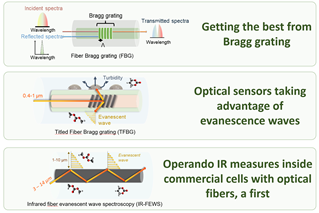
Bragg grating sensors (FBG) — Temperature, strain, and pressure in situ.
Integrating FBG and Fabry-Pérot sensors between the electrodes of commercial 18650 cells (NMC622/graphite) now makes it possible to simultaneously measure internal temperature, mechanical deformation, and pressure while the cell is operating. The measurements confirmed that the mechanical deformation tracked correlated with changes in the graphite’s volume, and revealed irreversible deformation after the first cycle, possibly linked to gas generation during the SEI (Solid Electrolyte Interphase) formation.
Tilted FBG sensors using evanescent waves (TFBG) — Monitoring electrolyte and ionic concentration.
TFBG sensors exploiting evanescent wave effects can track electrolyte wetting and local variations in lithium salt concentration. A three-sensor TFBG array distributed inside a 21700 NMC/Si cell provided spatially resolved data, revealing significant salt decomposition over cycling.
Operando infrared spectroscopy by fiber optic — Towards “Lab on the Fiber.”
By combining a chalcogenide fiber coated with indium tin oxide (ITO), an optical sensor that also serves as a working electrode was developed. This allowed reversible insertion/extraction of sodium in Prussian blue to be followed directly on the fiber using IR-FEWS spectroscopy, opening the path toward a “laboratory on a fiber” concept.
Pillar 2 — Multiphysics platform and AI database: BEAM (Battery Evaluation and Ageing Monitoring).
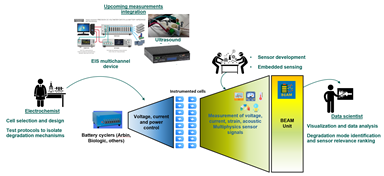
To overcome the limitations of conventional test benches (Arbin, Biologic), the BEAM (Battery Evaluation and Ageing Monitoring) platform has been developed. It features 16 synchronized cycling channels with high-precision voltage, current, temperature, and mechanical strain measurements, with modular architecture that also allows integration of EIS (electrochemical impedance spectroscopy), ultrasound, and FBG sensors. The data output uses a standardized format (TDMS) with structured metadata, making it directly usable by machine learning algorithms.
Detailed multiphysics characterization and cycling were carried out on two reference chemistries:
- Li-Ion LG M50LT — showing pronounced aging (79 % State of Health after 680 cycles) with noticeable acceleration of degradation below 90 % SOH.
- Na-Ion HINA MP10 — showing remarkable capacity retention (94 % SOH after 760 cycles).
The next steps include launching a large-scale campaign (100 cells) for cycling and aging with multiphysics measurements (electrical, mechanical, acoustic, optical). The resulting database, structured for AI, will feed the development of data fusion algorithms and physics-informed machine learning.
Autres Highlights