Recent Advances in the Stability of Nitroxides
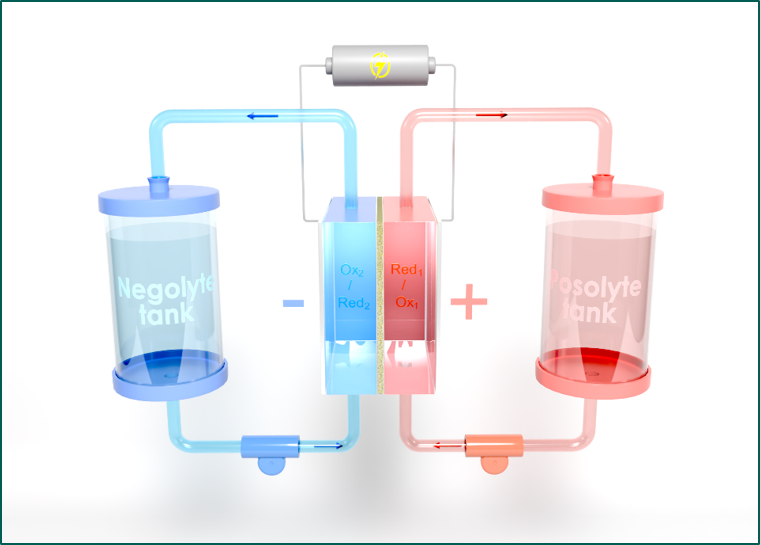
The RADICAL project aims to design a new, stable electrolyte for aqueous redox flow batteries operating at neutral pH, while adhering to a sustainable development approach. These batteries must overcome performance challenges—particularly in terms of electrolyte stability—to become a competitive industrial alternative to other technologies. A detailed understanding of the degradation mechanisms of redox-active species remains a major scientific hurdle in the development of aqueous RFBs, especially for organic nitroxide radicals, which are currently among the most promising candidates for next-generation posolytes.
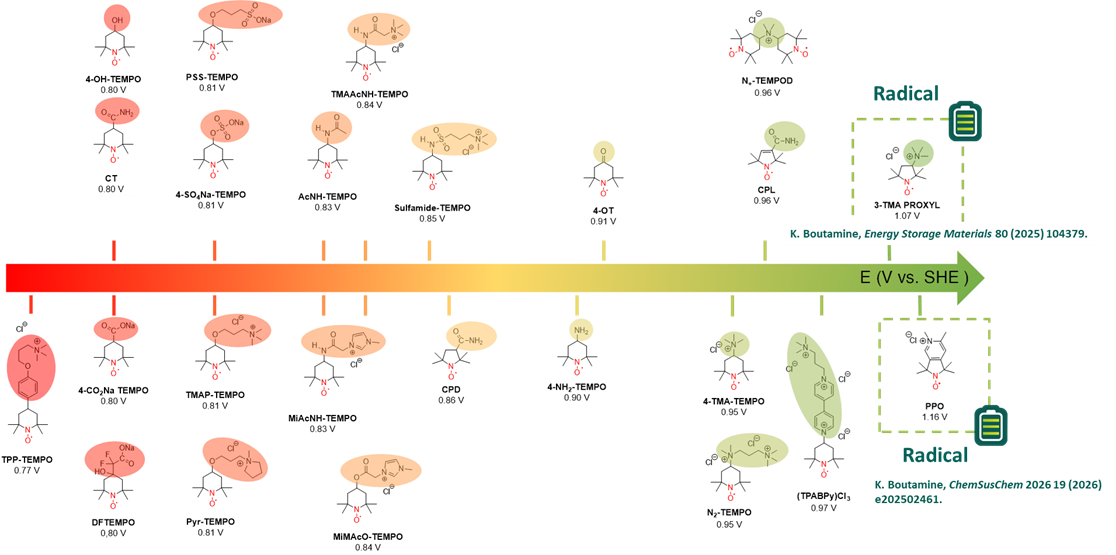
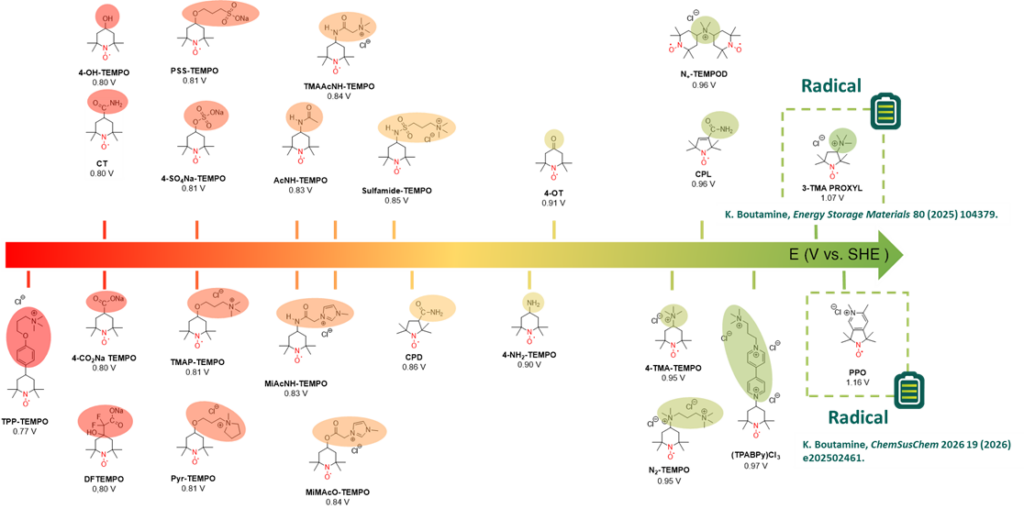
The consortium has implemented a coordinated strategy to select a number of nitroxide derivatives, enabling clear correlations to be established between molecular structure, electrolyte degradation, and battery performance. The first strategy focuses on studying the influence of substituents used to increase the potential and solubility of the compounds. The second strategy aims to investigate structural modifications designed to sterically hinder—and thus protect—the nitroxide function. Finally, the third strategy seeks to propose innovative molecular motifs never before considered in the literature. To date, the ICR in Marseille has synthesized seven molecules, several of which have been produced on a gram scale.
Two of these compounds have been studied in detail in 25 cm² batteries, resulting in two publications (https://doi.org/10.1016/j.ensm.2025.104379, https://doi.org/10.1002/cssc.202502461). Another study revealed that charge delocalization at the 4-position of the molecule did not improve compound stability (unpublished results). A key conclusion from this series of experiments is the significant pH variation (acidification) observed during battery cycling, confirming that the oxidized (charged) form of the nitroxide plays a predominant role in electrolyte stability. Operando EPR/battery coupling has enabled real-time monitoring of the evolution of oxidized and reduced species during battery tests (cycling, self-discharge) (unpublished results).
Autres Highlights