Angular Localization Function (ALF)
As part of the RADICAL project, we introduced a new function to analyse density profiles generated by Molecular Density Functional Theory (MDFT).
Molecular Density Functional Theory is a theoretical method that efficiently calculates the equilibrium density of a molecular solvent around an arbitrary solute. In practical terms, this density describes the average number of solvent molecules present at any given point in space, as well as their orientations. It therefore contains highly detailed information about the solvent structure. However, the sheer amount of information makes systematic analysis challenging. Spatial variations are generally interpreted using the number density, which is integrated over all orientations. By contrast, angular information is often overlooked due to a lack of practical tools for its interpretation.
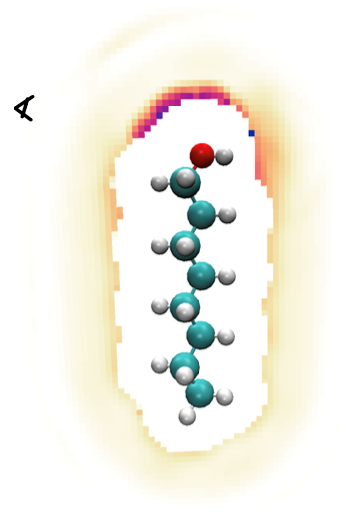
This work addresses this gap by introducing a function that provides a local measure of angular ordering: the Angular Localization Function (ALF), derived from the ideal free-energy functional, which represents a partial measure of entropy. We initially used ALF to analyse solvent structures around three types of solutes: a water molecule, an octanol molecule, and three clay minerals, whose subtle structural differences lead to nuanced effects on their interactions with water.
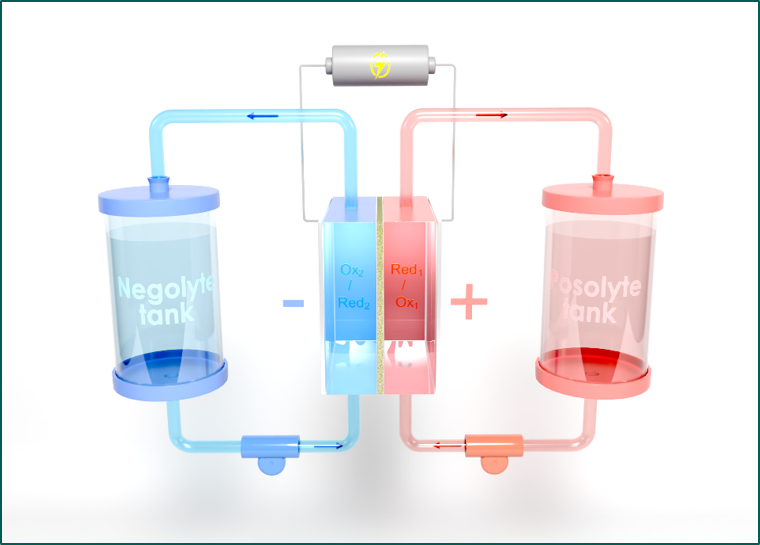
This work demonstrates that ALF provides complementary information to quantities such as average polarization and charge density, helping characterize the local orientational distribution of solvent molecules around solutes and near surfaces. It also serves as a practical visualization tool, which we now use to compare organic molecules being considered for use in redox flow batteries.
Article written by Maïwenn Souetre (PHENIX, CNRS / Sorbonne Université),
Benjamin Rotenberg (PHENIX, CNRS / Sorbonne Université),
Guillaume Jeanmairet (PHENIX, CNRS / Sorbonne Université).
Autres Highlights