More accurately simulating carbon electrodes using machine learning
The BATMAN project aims to develop new battery models by integrating data science and artificial intelligence approaches.
Zacharie Waysenson, Mathieu Salanne et Marco Saitta (Sorbonne Université)
Zacharie Waysenson will defend the first thesis funded under this project on September 11, 2026. His research focuses on modeling the charging mechanisms in power batteries energy storage devices capable of charging and discharging extremely rapidly, with an exceptionally long lifespan. A precise understanding of how ions organize and move within the carbon nanopores that make up their electrodes is essential for designing the next generation of these systems.
While molecular simulation has already contributed significantly to this field, two approximations have limited the realism of models until now: the rigidity imposed on carbon electrodes and the overly simplistic representation of their porous structure. In his thesis, Zacharie Waysenson specifically tackled these two challenges.
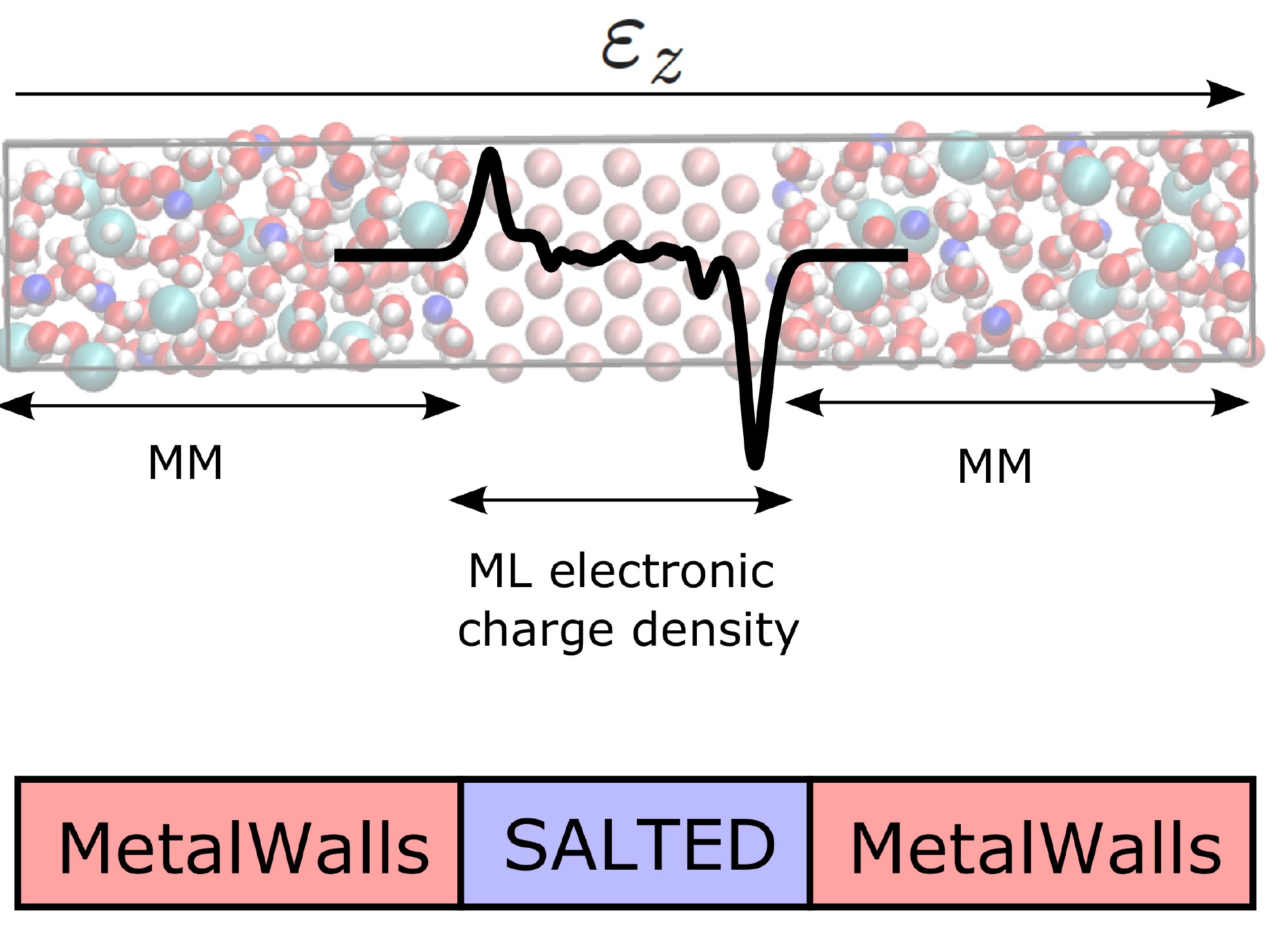
First, by combining a constant-potential molecular dynamics method with an interatomic potential learned through machine learning, Zacharie was able to simulate flexible carbon electrodes capable of locally deforming during charging. He compared their behavior to that of traditional rigid electrodes. His findings show that the flexibility of carbon significantly accelerates ion diffusion in the pores, reducing the characteristic charging time by a factor of 3, while maintaining a specific capacity consistent with experimental values (approximately 140 F/g). The analyses reveal that this improvement stems from a more efficient expulsion of co-ions and a more homogeneous and rapid redistribution of electrical charge in the material as soon as the voltage is applied.
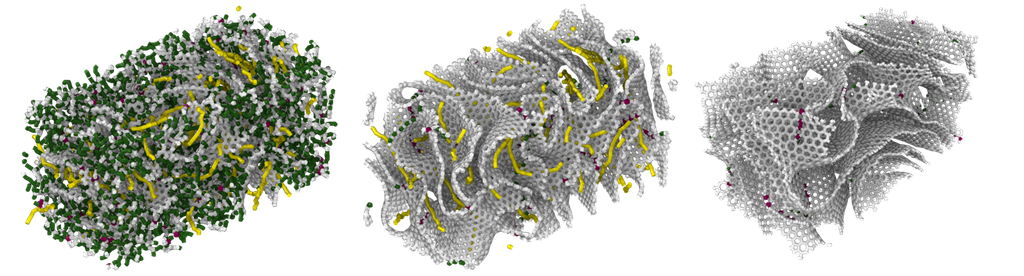
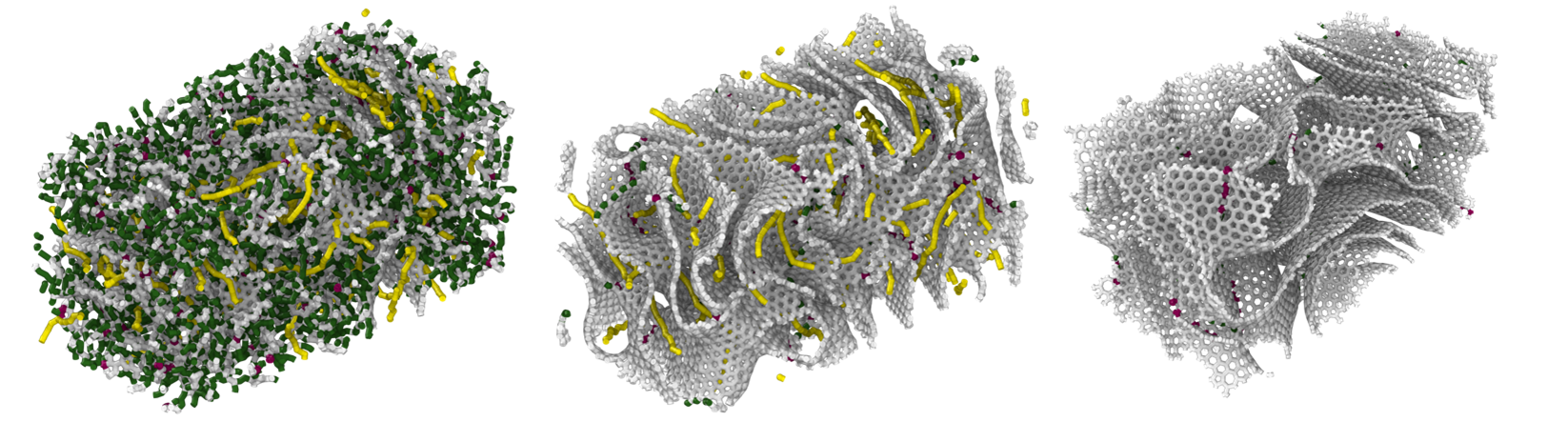
He then focused on investigating the microscopic origin of the abnormal capacity increase observed in nanoporous carbons a phenomenon long attributed to ion confinement in pores smaller than a nanometer, but which recent studies instead linked to the structural disorder of carbon. Zacharie developed an original computational soft-templating protocol, driven by a machine learning potential, to generate realistic, disordered carbon architectures with controlled pore sizes.
By simulating their charging at constant potential, he demonstrated that, for a given structural disorder, capacity indeed increases when pore size drops below a nanometer. Moreover, this capacity is significantly higher than that obtained from simulations of nanoporous graphenes with similar pore sizes. Zacharie’s work thus reconciles the two explanations confinement and disorder within a unified theoretical framework, in quantitative agreement with experiments.
These findings highlight the power of machine learning potentials to overcome the historical approximations of molecular simulation and open concrete avenues for the rational design of high-performance nanostructured carbons for electrochemical energy storage.
Autres Highlights