Electrochemical Functionalization of Porous Carbon Materials for Aqueous Supercapacitors
As part of her PhD, Rébecca Bazin developed an electrochemical functionalization strategy for self-supporting carbon electrodes that increases the stability window of aqueous supercapacitors while preserving their capacitive properties and improving their energy density. The formation of an electronically insulating, ion-conducting and hydrophobic film helped prevent parasitic reactions responsible for stability losses.
The HIPOHYBAT project aims to develop high-power devices as alternatives to lead-acid and lithium-ion batteries, targeting an energy density of 50 Wh/kg over one minute and 50,000 cycles for the complete device.
With the expansion of renewable energy and the increasing electrification of our daily lives, energy storage has become a major challenge. Among the available technologies, supercapacitors stand out for their ability to charge and discharge very rapidly and their excellent lifetime. Aqueous electrolytes offer several advantages: high ionic conductivity, low cost and non-flammability. However, their main drawback is their limited electrochemical stability window, due to parasitic reactions such as water decomposition and carbon oxidation.
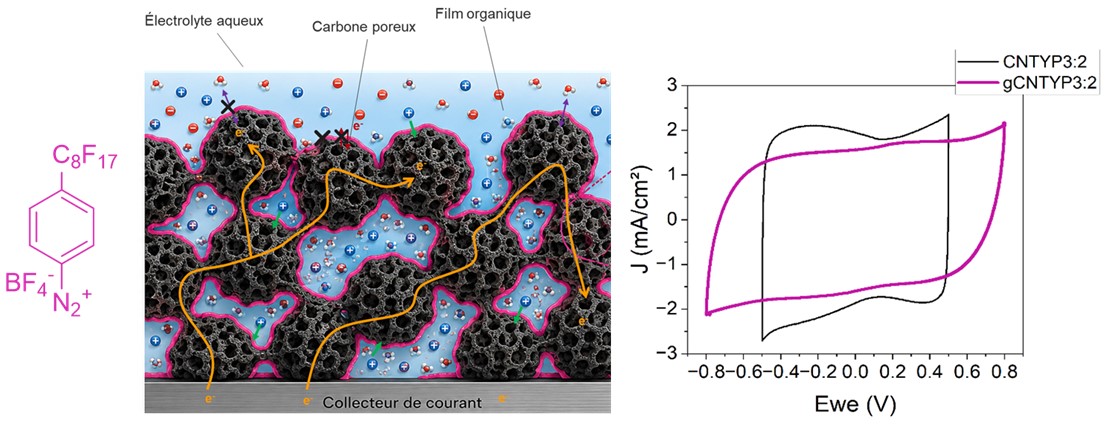
The aim of this PhD project was therefore to develop a strategy to protect the interface and prevent water molecules from coming into contact with the carbon surface, thereby limiting these reactions while preserving the electrode’s energy-storage properties. The strategy relies on the electrochemical functionalization of carbon materials using fluorinated diazonium salts. Their electrochemical reduction creates a hydrophobic organic film covalently bonded to the carbon surface.
Several fluorinated molecules were first investigated on model surfaces to identify the structure offering the best compromise between hydrophobicity and the suppression of electron-transfer reactions. This work led to the selection of a compound containing a long fluorinated chain, which proved particularly effective in modifying the interfacial properties: DS_C8F17.
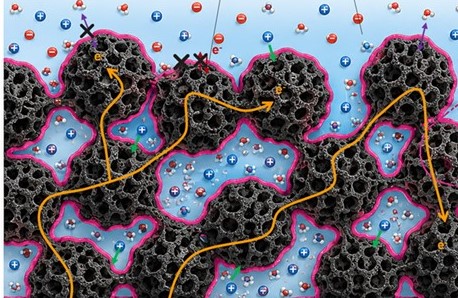
The strategy was then applied to three-dimensional porous electrodes made of carbon nanotubes and activated carbon (CNTYP). This architecture combines the good electronic conductivity provided by the nanotubes with the high specific surface area of activated carbon. A major challenge was to control the functionalization throughout the entire thickness of these electrodes: the film must provide sufficient coverage to limit parasitic reactions while remaining thin and permeable enough to allow ions to access the pores and preserve the storage capacity. Optimizing the functionalization conditions made it possible to obtain hydrophobic, passivated electrodes while retaining a substantial proportion of their electrochemical capacity. Modifying the carbon/electrolyte interface thus extends the operating voltage window of the electrodes from 1.2 V to 1.7 V and opens up the possibility of increasing the energy density of aqueous devices from 9.7 to 21.3 Wh/kg.
Beyond supercapacitors, this work provides a proof of concept demonstrating the potential of controlling the electrode/electrolyte interface to limit parasitic reactions in electrochemical energy-storage systems. It also paves the way for the development of new protective coatings, particularly those based on charged fluorinated molecules with ion selectivity tailored to the electrolytes used.
Rébecca BAZIN (CEA-IRAMIS), Bruno JOUSSELME (CEA-IRAMIS).
Autres Highlights