SCAR: Mock-Ups to Enable Robotic Battery Disassembly
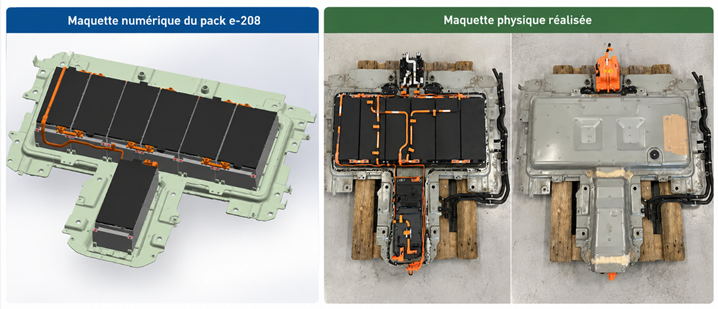
The SCAR (Safe and Circular Automated Recycling) project aims to make the disassembly of end-of-life electric vehicle batteries safer and enable the processing of the volumes expected by 2030–2035. However, automating this operation still faces several technical challenges, particularly due to the diversity of manual operations, variations in battery condition and the difficulty of replicating manual procedures using robotic systems. To characterise these challenges and prepare the development of suitable solutions, the consortium developed a digital model and a physical mock-up of a battery pack (project milestone M2).
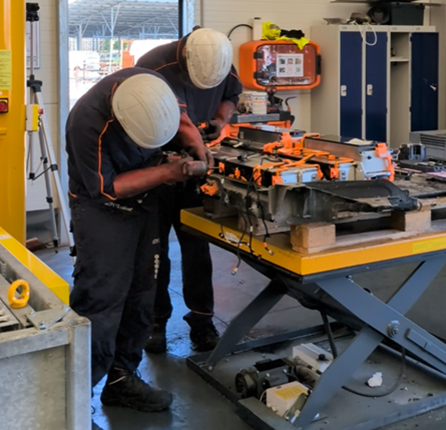
A real battery pack as a case study. The consortium selected the Peugeot e-208 battery pack as a practical case study. Comprising eighteen modules, it is representative of the European market. To ensure that the developments reflected industrial reality, the consortium visited GPA*, a professional vehicle dismantling company, where the various stages of manual disassembly were observed and timed.
These operations include opening the cover by cutting the sealing joint, disconnecting the 118 connectors and cable ties, which require different removal techniques, and then extracting the eighteen modules one by one.
Comparing these observations with models available in the literature revealed that 30% of the operating time is spent on tasks such as cutting the seal, reworking and preparatory operations that existing analytical approaches fail to model.
Although these operations are often difficult to anticipate and formalise, they represent major challenges for disassembly automation. The study therefore identified three complementary research areas.
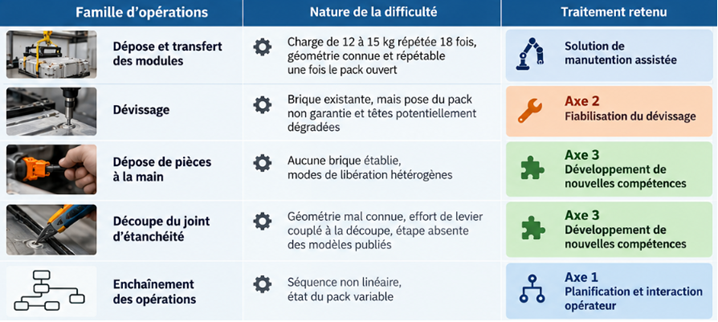
Three research areas for robotic automation. The first research area aims to equip the system with decision-making capabilities so that it can plan the disassembly sequence in real time, based on the observed condition of the battery pack. It relies on an agent-based architecture combining perception and robotic skills, complemented by an intuitive interface that allows the operator to take control when an unexpected situation arises.
The second area focuses on improving the reliability of screw removal when the battery pack is not clamped or secured in place. Each screw must be located in situ using vision systems, and the manipulation sequence must incorporate recovery strategies in the event of failure, while keeping processing time under control to preserve the time savings achieved through automation.
Finally, the third area aims to develop new robotic capabilities for operations for which no established solution currently exists, such as removing clip-fastened components and cutting seals. This approach relies on control laws combining force and position.
The development of the two mock-ups therefore represents a key milestone for the SCAR project, providing the necessary platforms for testing robotic approaches and progressing towards automated disassembly solutions suited to the diversity of end-of-life batteries.
*GPA (Livron-sur-Drôme, Drôme, France; www.gpa26.com) is an end-of-life vehicle collection and dismantling operator that hosted the consortium at its site and agreed to participate in the project as an industrial case study.
Caroline VIENNE (DRT/LIST/DIASI/SRI), Pierre KUNTZ (DES/LITEN/DEHT/STB/L2PS), Pascal DREVARD (DES/LITEN/DEHT/STB/L2PS), Héloïse HANNART (DES/LITEN/DEHT/STB/L2PC)
Autres Highlights